How NFPA 855 (2026), UL 9540A large-scale fire testing, and Gulf fire codes (UAE FLS Code of Practice, Saudi SBC 801) shape fire and life safety strategy for megawatt-scale data centers deploying EV-grade battery energy storage.
Battery energy storage systems (BESS) built on EV-grade lithium-ion chemistry are moving from the edge of the power network into the core of data centre design. This is a technical review of what is driving that shift, what the current codes require, where the underlying test data comes from, and what it means specifically for megawatt-scale projects in the UAE and Saudi Arabia.
Why EV Battery Chemistry Is Now a Data Center Design Input
Historically, the battery inside a data centre was a UPS string sized for a few minutes of ride-through until generators started. That is changing because AI-driven power demand is outpacing grid interconnection timelines. Operators are turning to grid-scale BESS — built on the same lithium-ion chemistries used in electric vehicles — to firm up power for hours rather than minutes. Utility-scale battery storage additions are being measured in tens of gigawatts in 2026, and some of the year's largest deployments, including a system exceeding 2,000 megawatt-hours announced in March, were purpose-built to support hyperscale AI campuses. Battery storage is no longer a backup asset; it is a primary input into how a data centre is sited, massed, and permitted.
The Core Hazard: Thermal Runaway in Confined Environments
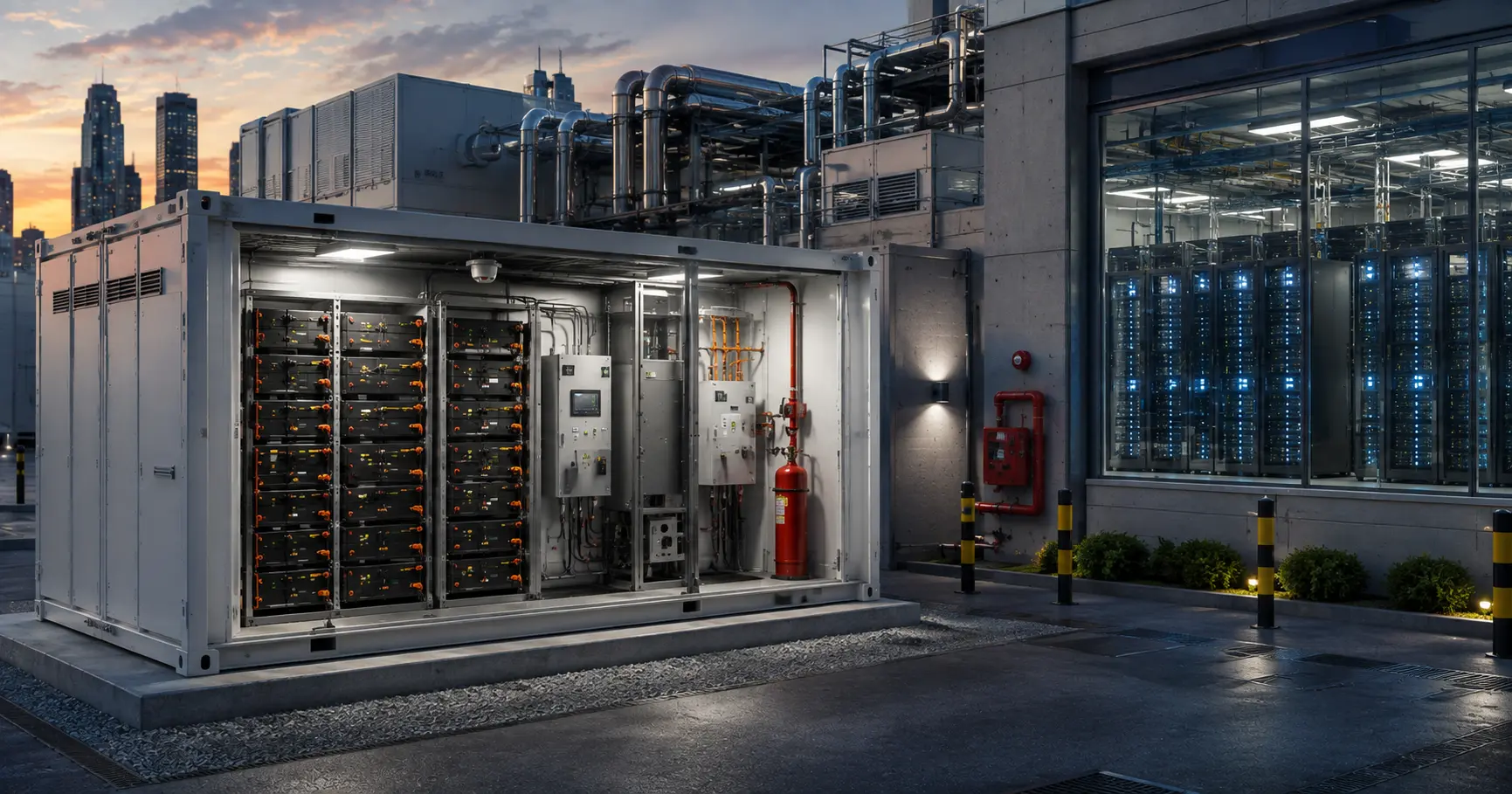
The underlying failure mode has not changed with scale: thermal runaway, in which a single failing cell releases heat and flammable, sometimes toxic, off-gas fast enough to propagate to adjacent modules before conventional suppression can intervene. What has changed is where these batteries are now being installed. Latency requirements and land constraints are pushing lithium-ion storage into basements, podium levels, high-rise mechanical floors and modular containers positioned between cooling plant — spaces that were not originally conceived around EV-scale battery venting or deflagration behaviour.
What Changed in NFPA 855 (2026 Edition)
NFPA 855 is the primary US-origin consensus standard governing stationary energy storage systems, and it is widely referenced internationally, including across the Gulf. The 2026 edition, released in September 2025, represents a substantive shift: it moves away from simple capacity-based exemption tables and increasingly requires a full Hazard Mitigation Analysis (HMA) for lithium-ion installations, supported by large-scale fire testing and an explosion-control system meeting NFPA 69. Detection requirements have also broadened under Section 14.3.2.1.2, now permitting smoke detection, thermal-imaging fire detection, or radiant-energy detection — correlated with NFPA 72 — rather than the narrower air-aspirating or radiant-energy-only approach in the 2023 edition. The 2026 edition also introduces new Thermal Runaway Propagation Prevention (TRPP) requirements under Section 9.7.6.6.
NFPA 800: A New Battery Safety Code on the Horizon
Alongside NFPA 855, NFPA is developing an entirely new Battery Safety Code, NFPA 800, intended to cover battery hazards across the full lifecycle — storage, transport, use and decommissioning — rather than storage alone. Public input on NFPA 800 closed in late January 2026. Once adopted, it is expected to complement or partially supersede the storage-specific provisions currently housed in NFPA 855's Chapter 14, which remains the only chapter in the standard focused specifically on lithium-metal and lithium-ion battery storage.
Where the Numbers Come From: UL 9540A and FM Global Data Sheet 5-33
It is worth being precise about the evidence base behind these code changes, since this is a fast-evolving area. NFPA 855's large-scale fire testing requirements draw on UL 9540A, UL Solutions' test method for evaluating fire and explosion propagation in battery energy storage systems — this is the closest thing to a standardised, repeatable body of test data behind the current code language, rather than a single research paper. FM Global's own engineering and research arm publishes Data Sheet 5-33, Lithium-Ion Battery Energy Storage Systems, which was revised in April 2025 specifically to align its prescriptive spacing and separation guidance with the 2026 edition of NFPA 855 and the large-scale fire test (LSFT) approach. Design teams should treat these as living references — both bodies continue to run additional test programmes as battery chemistries and enclosure designs evolve, and the guidance is updated accordingly.
Middle East Regulatory Landscape: UAE and Saudi Arabia
For megawatt-scale data centre projects across the Gulf, the regulatory picture is a step behind the US/NFPA cycle described above, and it is the part of this discussion most directly relevant to regional consultants and developers
In the UAE, the Fire and Life Safety Code of Practice — enforced through Dubai Civil Defence (DCD) and Abu Dhabi Civil Defence (ADCD) — references NFPA standards extensively but does not yet contain a dedicated lithium-ion battery or BESS chapter; large lithium installations are currently handled through flammable and dangerous-goods provisions. Dubai's Law No. 4 of 2025 tightened dangerous-goods handling requirements, introducing fines of up to AED 1,000,000 for non-compliant storage or undeclared shipments, and requires classification per international standards such as UN 3480. Abu Dhabi Civil Defence's 2026 prevention updates place additional emphasis on lithium-ion and EV charging awareness, alongside mandatory integration with the Hassantuk alarm-monitoring network. In practice, on the megawatt-scale projects currently going through approvals, the FLS strategy is typically built around an NFPA 855 Hazard Mitigation Analysis, which is then negotiated directly with DCD or ADCD as the reviewing authority — the HMA functions as the de facto performance-based compliance route in the absence of a codified local chapter.
In Saudi Arabia, the Saudi Building Code's fire volume, SBC 801, is explicitly built on NFPA 1, NFPA 13, NFPA 72 and NFPA 101, and is enforced jointly by municipalities at permit stage and the General Directorate of Civil Defense (GDCD). As with the UAE, SBC 801 does not currently carry a dedicated lithium-ion battery storage chapter, so lithium-ion BESS on large campuses similarly ends up relying on an NFPA 855-based HMA as the technical basis for approval, supplemented by SASO equipment standards and Civil Defense sign-off.
The practical implication for both jurisdictions is the same: because local code has not yet caught up with the pace of BESS deployment, the quality and defensibility of the HMA — and the relationship management with the reviewing Civil Defence authority — currently carries more weight in the Gulf than it might in a jurisdiction with a mature, codified lithium-ion chapter.
Engineering Response: Design Priorities for 2026 Projects
Treat the Hazard Mitigation Analysis as a live design input, integrated into concept master planning alongside power and cooling, rather than a document produced late to unlock a permit.
Design detection as a layered, multi-technology stack — smoke detection, thermal imaging and radiant-energy detection working together — consistent with the 2026 NFPA 855 revisions, rather than relying on a single technology.
Size compartmentation, pressure relief and deflagration venting to actual room geometry and airflow, not generic spacing tables, particularly for basement, podium and modular container deployments that fall outside the classic outdoor BESS enclosure model.
Design ventilation to safely dilute and exhaust flammable off-gas rather than recirculate it into occupied or adjacent spaces, and pair this with off-gas monitoring and battery-management-system (BMS) analytics to catch early indicators of cell failure before thermal runaway fully develops.
Evaluate immersion and direct liquid cooling as a thermal-propagation barrier, not only as an energy-efficiency measure, since dielectric fluid can slow cell-to-cell escalation in ways air-cooled cabinets cannot
Select suppression on a zone basis — clean agent or inert gas where IT equipment protection matters, in line with guidance from NFPA 2001 and standard data centre practice, recognising that lithium-ion battery fires may still require overhaul and monitoring even after initial suppression.
Build Civil Defence and community engagement into the FLS scope explicitly, particularly in the UAE and Saudi Arabia where the HMA doubles as the primary negotiating document with the authority having jurisdiction.
Where This Is Heading
The convergence of EV-grade battery chemistry and critical digital infrastructure is one of the more consequential shifts fire and life safety engineering has faced in years, and the Gulf's data centre pipeline is scaling faster than local codes are being rewritten to govern it. Until the UAE and Saudi codes carry their own dedicated lithium-ion battery provisions, the NFPA 855 Hazard Mitigation Analysis will remain the practical backbone of FLS strategy for megawatt-scale battery storage in the region — which makes the quality of that analysis, and how early it enters the design process, the single biggest variable in how smoothly these projects move through approval.